


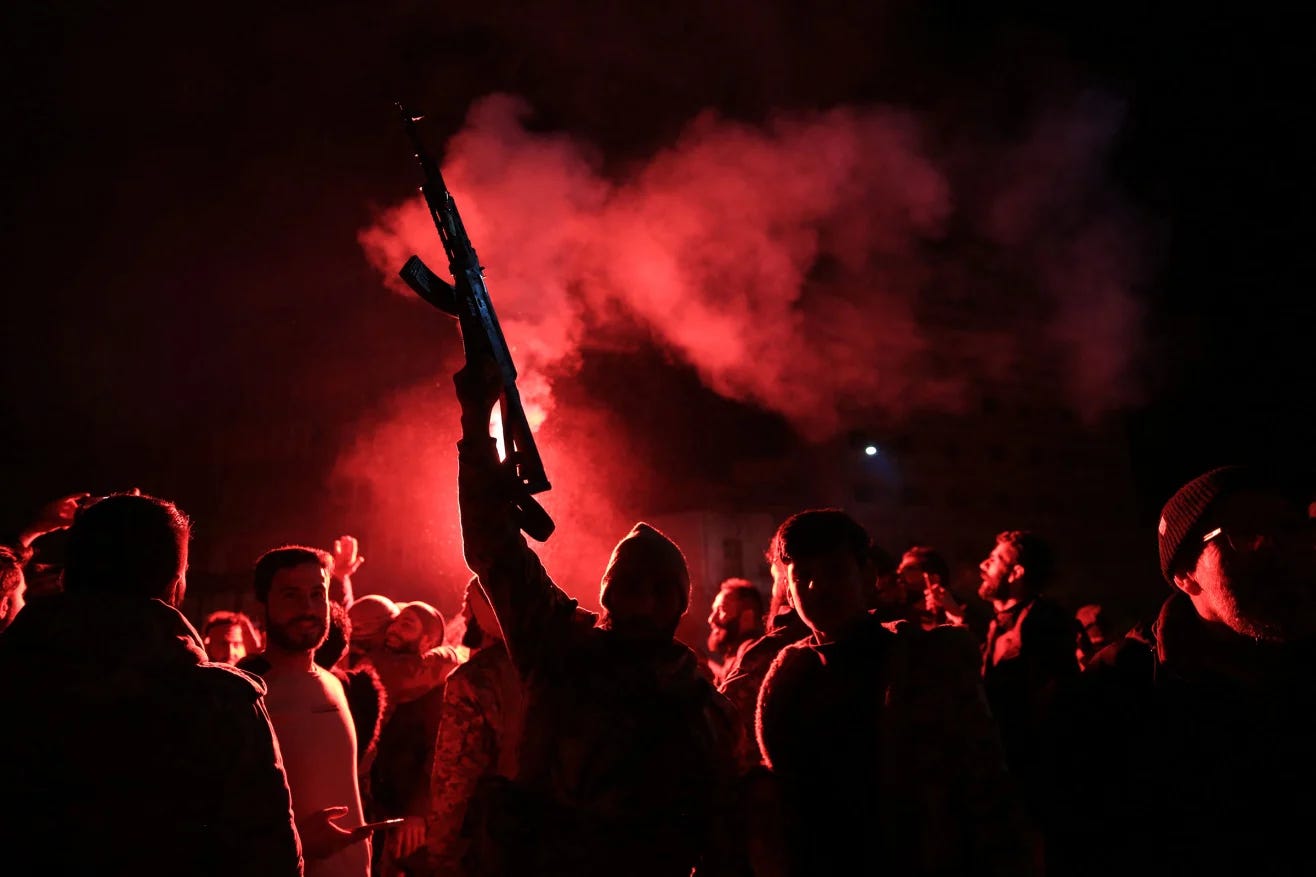
Bashar al-Assad, the butcher who gassed his own people, purveyor of a 1.5 km human torture chamber, and the operator of a totalitarian narco-state for half a century, has finally been deposed. This tyrant did not get to cede power willingly; there was no dignified surrender of dictatorship in accordance with a referendum, no passing of the torch with the dignity of a state funeral à la Francisco Franco. Instead, like all of his ilk, he ran. Mr Assad, contrary to his self-stylised title of ‘lion’, fled in the middle of the night, his shisha coals still running red-hot in the presidential palace, on a flight to Moscow — where he no doubt will seek solitude under the umbrella of his equally contemptible patron and bankroller, Vladimir Putin. It is a fitting manner of irony that Mr Assad be forced to flee, like so many of the Syrian refugees he victimised, but one finds it regrettable that Syrians will not be able to enact much-deserved justice upon him, on behalf of a country he and his cronies bled dry.
Viral footage on X depicted jubilant Syrians atop the desecrated bust of Hafez al-Assad, literally breaking the personification of a dynasty built on nothing but fear. Rebel forces poured into “the Red” Sednaya prison — where the worst horrors of more than a half-century of Assadist rule manifested. Many of the prisoners had been removed from the world to the point where they found shock, not only at the demise of Hafez, who had perished in 2000, but at the nature of the rebels — who were mistaken for being soldiers of Saddam Hussein, who had been deposed in 2003. Videos revealed underground cells, many of which had been sealed with concrete, and fighters struggling to pull survivors out. Most odious and sinister of all was the presence of newborns and children within the prison, overwhelmingly the product of rape by prison guards against women held captive by the regime. Amnesty International once estimated up to 15,000 extrajudicial executions, with the Syrian Observatory’s number, since the civil war began in 2011, nearly double that. Regardless of the nature of many of Syria’s rebel groups, those poised to grandstand about ‘potential Islamist spillover’, ‘destabilisation of the region’, and ‘dire consequences’ should comb through videos of the atrocities within Sednaya. Think of the children. The liberation of Syria is an unquestionable good.
Now who actually took Damascus is a different affair entirely, and may prove bad. Abu Mohammad al-Julani, the leader of these rebels, is a designated and sanctioned terrorist with a $10 million bounty on his head from the State Department. It is his Hayat Tahrir al-Sham (HTS), formerly Jabhat al-Nusra — the Syrian franchise of al-Qaeda — that launched the offensive last week that retook Aleppo in less than four days after years of impasse, which was a consequence of the March 2020 Idlib ceasefire. It would appear neither work-from-home nor COVID could hamper HTS’s productivity. Julani, stylising himself now by his birth name of ‘al-Sharaa’, insists to media interviewers that the man, now in his forties, is not the radical alumnus of Sednaya in his twenties who spent his adolescence fighting coalition forces in Iraq. Perhaps; though one would be forgiven for expressing scepticism at taking the word of a man so intimately linked to al-Qaeda, whose group, per the DNI, seeks “a government guided by a fundamentalist interpretation of Islamic law.” Great. Anyone who makes any concrete predictions on Syria’s future, no matter how well informed, is telling you more about their presuppositions than anything empirical.
No doubt from Washington, to London, to all across mainland Europe, the isolationists find themselves sat smug, boasting how “this proves non-interventionism was the right course all along!” Let us be plain about it: this war — more this catastrophe — which began as a popular uprising by a people tired of cronyism, an authoritarian state, and starvation that then curdled into a deadly Sunni-Shia civil war that has killed over half a million people, brought about the rise of an Islamic caliphate, destabilised the entire Middle East, and instigated a migration crisis into Western Europe that has had both existential humanitarian and political implications. With the keys to Damascus falling onto the keychain of a jihadist not by virtue of right, or even might, but more so by happenstance of being the last man standing, that is the embodiment of American abdication, rather than the product of intervention.
In 2011, when Syrians saw the uprisings across the rest of the Arab world, they took, peacefully, to the streets with a simple demand — the world’s backing against a dictatorship more brutal than Mubarak ever was. Barack Obama, in all of his wisdom, elected to do nothing, but then equivocate, all while encouraging Syrians rhetorically about how “Bashar must go” whilst offering little with regard to how that would be implemented, save for moral platitudes. Mr Obama’s inaction likely stemmed from the fact that toppling such an ally of the Mullahs in Tehran, his long-standing unrequited crush, would likely draw their ire and derail his back-channel nuclear talks. Mitt Romney was scolded by the administration and their mouthpieces in the media for complaining about how Washington never seemed interested in backing liberal reformers and conjuring up a decisive alternative to Assad. While many rebels indeed were well-intentioned, they would always be felled by the jihadists who were supplied with guns equally — who took it upon themselves to utilise these weapons against their fellow rebels. Morals have limited sway in a region where guns matter more than honourable intentions.
Then in 2013 the greatest atrocity of this century took place. In August, forces of the Assad regime, under direct orders of the Syrian dictator, attacked the suburb, overwhelmingly a populated civilian region filled with families and children, with sarin gas — killing hundreds of civilians, and leaving survivors to watch those around them slowly convulse and die. It was a bluff on the West called by Mr Assad, a clear violation of a ‘red line’ against chemical weapons that Mr Obama had drawn, on the global stage, behind the seal of the presidency of the United States. The Obama administration staked its entire credibility on this. Foreign policy is a game in which the threat of what you could do often matters more than what you do.
But Mr Obama did nothing. No strike came. His red line evaporated as though it had been washed away by the sands. Despots across the world watched the President of the United States announce a limit and then watch it crossed without consequence. In Westminster, Prime Minister David Cameron attempted to whip the House of Commons in support of a strike against Assad but met a humiliating defeat for his government as it lost the vote. America’s weaknesses emboldened its adversaries and exacerbated fears among its allies: “is the United States reliable?” Every friendly and rival power watched the tape — Mr Obama’s lips repeating that “[if] we start seeing a whole bunch of chemical weapons moving around or being utilized… that would change the equation” and doing nothing.
Vladimir Putin watched that tape, and annexed Crimea just half a year later. In 2015, he ordered a military intervention into Syria under the guise of stabilising a region at risk of falling to the Islamic State, a dividend of Mr Obama’s bungled withdrawal from Iraq in 2011, and of his refusal to implement any unified military strategy against insurgents, which was now threatening the entire world. In reality, however, instead of striking against the Islamic State, Russian forces merely existed to prop up Assad — bombing anything labelled a ‘terrorist’, which turned out, ninety-eight per cent of the time, to be civilians and the moderate opposition among them engaging in activities such as waiting in breadlines or operating hospitals. Mr Putin began deploying ground soldiers and embedding Russian advisors within the Syrian military, with Putin positioning Russia as a staunch ally to beleaguered regimes and a guarantor of regional stability, no matter the cost to human lives.
That is what an unenforced American red line purchases. When the West abdicates any responsibility, authoritarian actors are always delighted to fill the resulting vacuum. To the isolationists who have come to dominate the Republican Party since 2015, pushing out those much-scorned “warmongering neoconservatives” and “hawks” like myself and others, I say that we have run your experiment and can look at what came. Half a million dead, the rise of ISIS, an empowered Russia in the Middle East, and a migrant crisis that fuels your populist politics — while being caused by it.
Non-interventionists can heap no laurels upon themselves; Assad’s collapse was, if anything, accidental and a cascading event of other people’s exhaustion. This is not to take away anything from Syrians, who showed an unbelievable amount of tenacity, endurance, and zealotry in deposing the monster, but the true anchors of his demise fall in Eastern Europe and neighbouring Lebanon. Ukrainian resistance to Vladimir Putin’s brutal invasion, courtesy of the support of a NATO alliance that chose resolve rather than weakness, has eradicated much of Russia’s military muscle, particularly in its aerial capabilities. In Beirut, Israel’s manoeuvre against Hezbollah’s command structure courtesy of the pager bombs operation destroyed the command structure that was able to orchestrate Hezbollah’s brutal intervention on behalf of Assad. Assad did not fall because non-interventionism was correct — morally or geopolitically. It fell because the murderous tyrants backing him had to focus on other murders elsewhere. Washington’s policy of tepidness did not yield any positive developments.
Borrowing from his old boss Obama, President Biden’s approach to any Middle East development has been to bomb from afar and wash one’s hands clean. Seventy-five ISIS targets were bombed in Syria as a result of the Assad regime’s collapse, so that the fledgling remains of the caliphate could not have an opportunity to utilise the fall of Assad to prop themselves up or seize control of chemical weapons stockpiles. Fine as far as it goes; ensuring the caliphate does not benefit is needed, but the cynical side of it is that it epitomises the past decade of American foreign policy — go in with bombs, blow things up, and hope the people on the ground sort it out for themselves (and remain grateful for the privilege!).
Who says it will be sorted out well? President-elect Trump went on a tirade about how we should “LET IT PLAY OUT” and “NOT GET INVOLVED!” in his characteristic all-caps style via Truth Social. The question is why he felt it prudent to comment at all, considering how “let it play out” was the modus operandi of the Obama administration when it oversaw the peak of the Syrian Civil War. Ghouta is what “not getting involved” produced.
And it could get darker yet. Unlike in Baghdad twenty years ago, there are no coalition forces to keep the peace, no institutionalists drafting up constitutions, and no Western oversight into the reconstruction process. The war began as a fight for freedom, but did not end as one, rather a Sunni-Shia blood feud with Iranian-backed militias and Islamists drawing upon foreign fighters on the other. In the absolute worst case, one need not imagine — we saw it under a black banner with a white circle ten years ago — we will see scores being settled, with the Alawites being massacred as infidels and enablers of the Assad regime, Christians being put to the sword after managing to avoid the worst of tit-for-tat violence by staying silent, and against the Shia as a whole. Even if Julani attempts to govern with the best of intentions, is it preposterous to be concerned that those under him who have grown so accustomed to war will find it difficult to restrain themselves?
More urgent is whatever supply of chemical weapons Bashar al-Assad may have hidden away. It needs to be the priority of governments within the region and hopefully a point of co-operation by the outgoing Biden and incoming Trump administrations to find or destroy whatever remains of this arsenal. The absolute worst-case scenario would be for these weapons of mass destruction to fall into the wrong hands via land, ship, or air.
Assad’s fall will prove to be a positive overall. Brutal dictators deserve to face justice and though the Syrian people avoided enacting justice against him, one could consider it fitting that Bashar will spend the rest of his years exemplified as a fleeing coward, a hilarious turn of events for the “lion of Damascus” who would decorate the country with grandiose portraits of himself in military regalia, full of undeserved medals, typically reserved for bravery. But the men who now walk the halls of his presidential palace did not spend the last decade fighting for liberty, equality, and fraternity — terrorists by the definition of the State Department. Both are true, and one need not rigidly pick one line of thinking. Anyone who demands such would compel the cessation of critical thinking, and they are not a friend of a free Syria.
Continuing in the stride of cautious optimism, one hopes that this is not the last of such days in the Middle East. Assad rots in Moscow, his face and ideology denigrated and desecrated. In Tehran, a much older yet equally as murderous dictator ought to be losing sleep. If providence has justice, he will be next.