


I finally have decided to return to writing after months of hiatus being preoccupied with university. Given that I live in London, I believe I may end up covering more global affairs than I had previously, and likely will pivot to covering more domestic matters here in Britain. But do expect more to come!
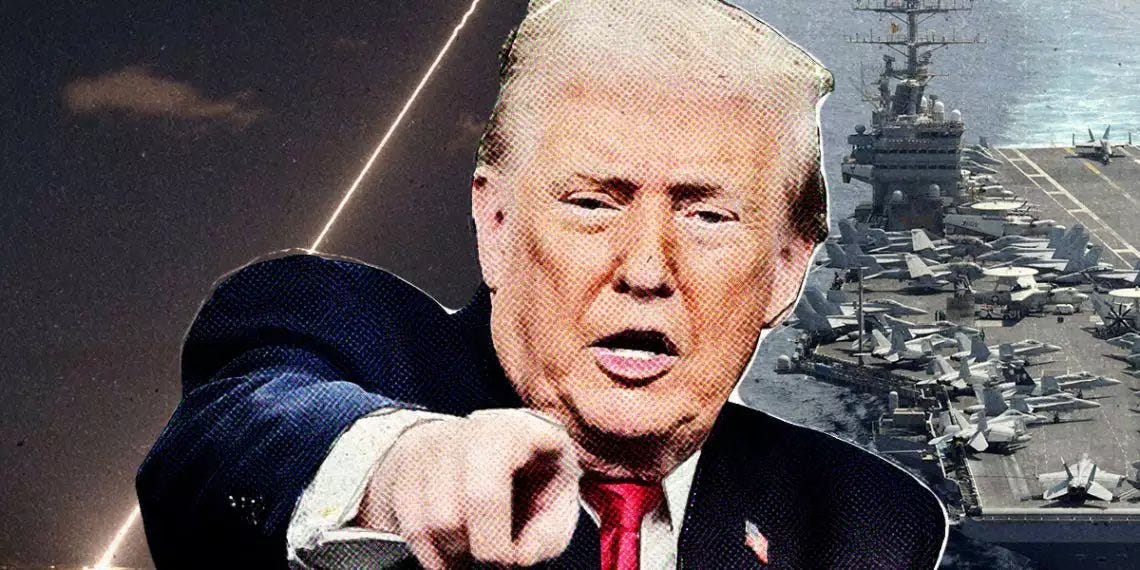
Donald Trump’s actions in both Venezuela and the newest war with Iran have successfully reversed twenty years of foreign policy humiliations, inactions, and catastrophes. If one had told previous architects of U.S. interventionism in 2004—Bill Kristol, Paul Wolfowitz, Richard Perle, and David Frum—that it would be the host of The Apprentice and a man who plasters his face and name onto steaks and vodka who would topple the Ayatollah and potentially his Islamic Republic—the most powerful of the ‘Axis of Evil’—one would scarcely imagine they could comprehend it.
Throughout this term—and his previous one—critics of the left have relentlessly attacked Mr Trump’s foreign policy as lacking any moral foundation, coherent strategy, or basic stability (at times calling it downright erratic and reckless—talk of annexing Canada and Greenland springs to mind). This is all true. However it contrasts vis a vis endless inaction which has done nothing except grant malicious regimes licence to violate those very conventions with complete impunity. This is the same crowd that sneered at Ronald Reagan for daring to call the Soviet Union “an evil empire” and for any serious effort to confront communism or terrorism. They preferred endless concessions dressed up as “détente”—in spite of the irrefutable evidence that, had the U.S. pressed harder and earlier, the Iron Curtain might have fallen a decade sooner. They were wrong then. They’re wrong again now.
One need only look at Ben Rhodes and President Obama, who believed that elevating Iran to a regional power by allowing its nuclear ambitions at a later time and enabling the procurement and building of ballistic missiles would counter both Israel and Saudi Arabia and enable Tehran to compel Israel to withdraw from the West Bank. In the minds of Mr Obama and Mr Rhodes it never occurred that Tehran could be toppled by indirect or direct force, but that there was an inevitable legitimacy surrounding the Ayatollah’s fascistic regime and that only through peace could Iran’s nuclear ambitions be deterred. American foreign policy regarding the regime—from President Carter with the hostages in ‘79, President Reagan’s failure to respond to the Beirut bombings, the execution of torture of CIA chief William Buckley and SW2 Robert Stethem in 1985, and President Bush’s failure to retaliate for the torture of Colonel Higgins in 1989—could simply have been solved with an air strike. It is truly as straightforward as that.
The Venezuela operation, conducted meticulously, was prime evidence of the efficiency of the United States military and the success of regime change when deployed effectively. Rather than waste ten years battling insurgents, billions in rebuilding, and trying to convert foreign populations to Western liberalism (while air dropping corrupt leaders like Hamid Karzai who had lived outside the countries for decades to micromanage), the Trump approach is simply to remove elements of a government that are undesirable and elevate those, from within the previous government, who can be reasoned with. Acting President Delcy Rodríguez is from the same ideological bend as Maduro, his Vice President, and in spite of this similarity has freed political prisoners and opened up the country to U.S. investment and oil. Without losing a single American soldier, or expending resources in a complicated transition of governments, rewriting of constitutions, and quelling resistance forces—America simply removed the hostile actor and replaced him with a mild one.
Pearl clutching about international law should cease. If the United States can remove a hostile regime, one guilty of numerous humanitarian violations and acting to harm the United States, then why shouldn’t it? Why should those who flagrantly violate international law and commit unspeakable atrocities find themselves under its protection? The West should tackle these regimes the same way it tackled communism under Reagan—by halting them, not trying to change their behaviour. “We win, and they lose.”
It would be wise for the the administration, to be pragmatic, rather than rigid, with what comes in the wake of the Ayatollah’s demise. For whatever replaces him, no matter how different, is certainly for the best—and be it next week, months, or a year from now the Islamic Republic’s days are numbered and for the first time in a half century hope beckons for the Iranian people. So long as Trump follows through.